Indian Sandstone Patio Restoration in Ryton, Gateshead – Cleaning, Repointing & Sealing
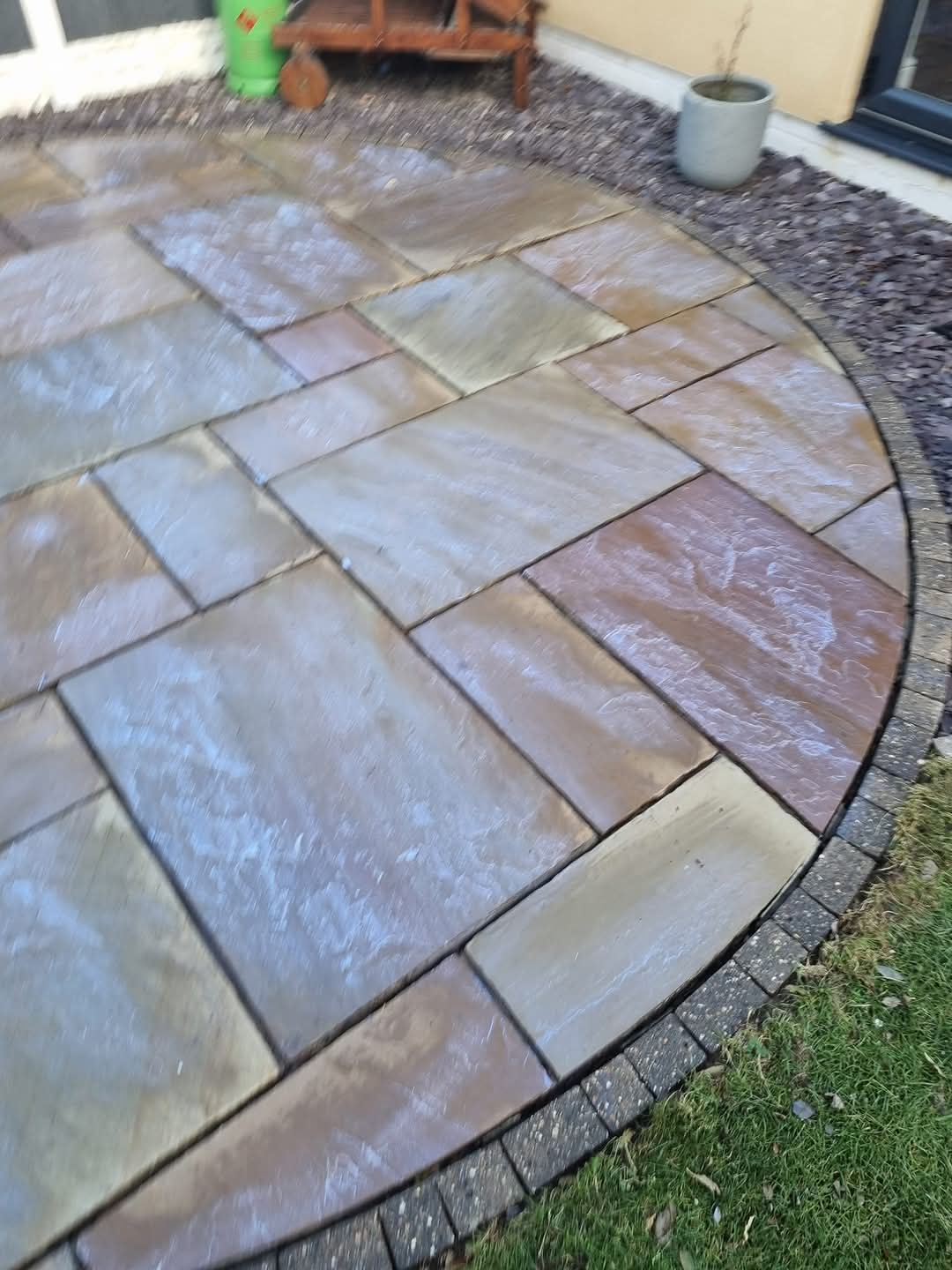 After
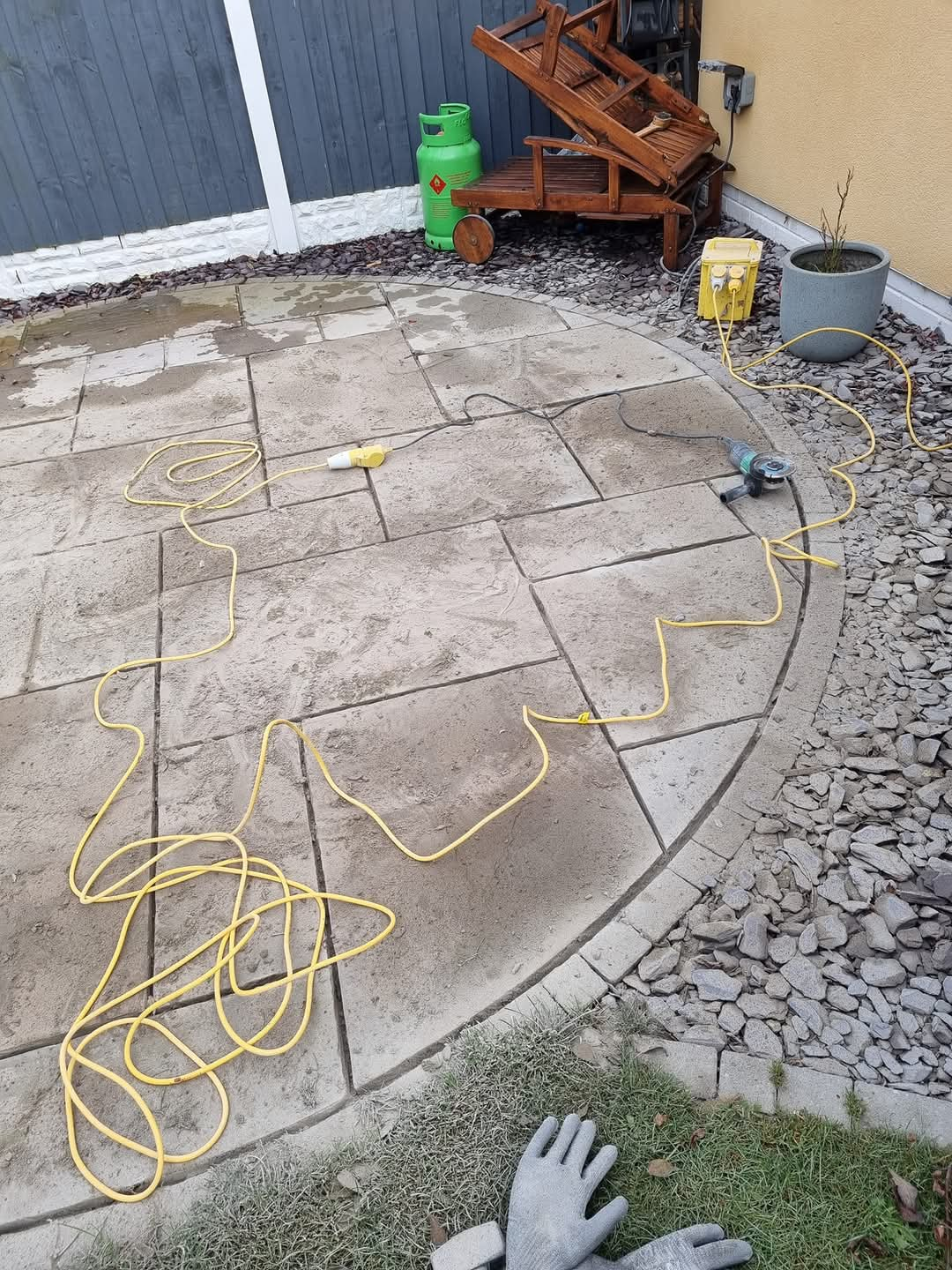 Before
Project Overview
Supreme Exterior Clean was contacted by a homeowner in Ryton, Gateshead, to undertake the complete restoration of a 45m² Indian sandstone patio that had deteriorated significantly since its installation five years earlier.
Over time, the natural stone had become heavily contaminated with general dirt, organic growth, stubborn black spot and areas of rust staining. The paving had also become slippery when wet, making it less pleasant to use.
In addition to the surface contamination, much of the original jointing compound had begun to fail. Several joints had deteriorated considerably, while others were missing altogether, leaving the patio looking untidy and poorly maintained.
The patio had never previously been professionally cleaned or sealed.
Our objective was to restore the natural beauty of the Indian sandstone, replace the deteriorated jointing and provide a protective finish that would enhance the appearance of the stone while making future maintenance easier.
The result was a comprehensive restoration that left the patio looking, in the customer's opinion, even better than when it was first installed.
The Challenge: More Than Just a Dirty Patio
Although the patio was only five years old, several different problems had developed, each requiring a specific approach.
1. General Dirt and Organic Contamination
Years of exposure to the British weather had allowed general dirt and biological contamination to accumulate across the sandstone.
As the surface became increasingly contaminated, its natural colours were obscured by a dull, grey appearance.
Organic growth also contributed to the patio becoming slippery during wet conditions.
2. Stubborn Black Spot
One of the more challenging forms of contamination was black spot, a term commonly used to describe persistent dark biological staining on exterior paving.
Unlike loose surface dirt, black spot can be particularly difficult to remove through pressure washing alone.
Successful treatment often requires an appropriate specialist biocidal cleaning solution to break down the contamination.
3. Rust Staining
Several areas of the patio were affected by rust deposits associated with iron garden furniture.
As moisture came into contact with the metal furniture, corrosion products had transferred onto the sandstone, creating discoloured patches.
Rust staining requires a different treatment from organic contamination. Conventional pressure washing and general patio cleaning chemicals are often insufficient to remove these deposits.
4. Failed Patio Jointing
Perhaps the most noticeable structural maintenance issue was the deterioration of the original jointing.
Several joints had become loose or damaged, while others had lost their jointing material completely.
This created an uneven and untidy appearance, with gaps between the individual sandstone paving slabs.
Simply cleaning the patio would not have resolved these issues.
To deliver a comprehensive restoration, the defective jointing needed to be removed and replaced.
Our Solution: A Five-Stage Patio Restoration Process
Rather than treating this as a straightforward pressure washing project, we developed a restoration process that addressed each problem individually.
Stage 1: Removal of the Existing Jointing
The first stage involved removing the deteriorated jointing material from between the Indian sandstone paving slabs.
Our technicians used an angle grinder to carefully cut out the existing compound.
This process required particular care and attention.
Indian sandstone has relatively vulnerable edges, and careless use of mechanical cutting equipment can chip or permanently damage the paving.
The grinder therefore had to be controlled precisely to remove the unwanted jointing while preserving the surrounding stone.
Removing the defective material provided the necessary preparation for installing the replacement compound later in the restoration.
Stage 2: Hot Water Pressure Washing
Once the old jointing had been removed, we carried out a thorough clean of the entire patio.
A professional hot water pressure washer was used in conjunction with a flat surface cleaning attachment.
This equipment allowed us to clean the large paved area efficiently while maintaining a more consistent cleaning pattern than would typically be achieved using a conventional pressure washing lance alone.
The hot water helped loosen accumulated dirt and grime, revealing more of the sandstone's original colour and natural texture.
However, pressure washing alone was not sufficient to remove all the contamination.
Further specialist treatments were required.
Stage 3: Specialist Black Spot and Rust Stain Treatments
Following the initial pressure washing, we addressed the remaining stubborn staining.
Black spot treatment
We applied a sodium hypochlorite-based cleaning treatment to tackle the persistent black spot contamination.
This chemical treatment was selected for its effectiveness against biological staining that can remain visible even after thorough pressure washing.
The treatment helped restore a cleaner, more uniform appearance across the affected sandstone.
Rust stain removal
Areas affected by rust staining received a separate treatment using Iron X, a specialist rust-removing product.
Unlike the biological contamination, rust deposits required a chemical treatment specifically suited to the removal of iron-related staining.
Treating the different contaminants separately allowed us to achieve a more comprehensive result than would have been possible with a single general-purpose patio cleaner.
Stage 4: Repointing with ProJoint TITAN
Once the paving had been cleaned and the necessary surface preparation completed, we installed new jointing using ProJoint TITAN, a specialist two-part resin-based brush-in jointing compound.
The product was worked into the prepared joints to create a neat, consistent finish between the sandstone paving slabs.
Proper joint preparation and installation are important for achieving a durable result.
The new jointing significantly improved the overall appearance of the patio, replacing the previously damaged and missing material with clean, uniform joints.
The contrast between the refreshed sandstone and the new jointing also helped emphasise the individual paving slabs and the patio's layout.
Stage 5: Colour-Enhancing Sealer Application
The final stage involved sealing the restored sandstone using PureSeal Enhance & Seal, a specialist colour-enhancing paving sealer.
Indian sandstone is naturally available in a wide variety of colours, including buff, brown, grey, green and subtle purple tones.
Over time, these colours can become less noticeable as the surface becomes contaminated and weathered.
Although cleaning reveals the natural stone beneath the dirt, a colour-enhancing sealer can take the finished appearance a step further.
The sealer enriched the natural colours and variations within the sandstone, giving the patio a more vibrant finish.
It also provided a protective treatment intended to reduce the absorption of certain contaminants and make routine maintenance easier.
The combination of thorough cleaning, new jointing and colour enhancement transformed the appearance of the patio.
Project Management: Four Visits, Approximately 14 Working Hours
The restoration required approximately 13–14 working hours, completed over four separate visits.
Spreading the work across multiple visits allowed the different stages to be completed in the correct sequence, while accommodating the preparation, drying and curing requirements associated with the selected jointing and sealing products.
This was particularly important because professional patio restoration involves more than simply completing each task as quickly as possible.
Surface condition, moisture levels, weather conditions and product requirements all need to be considered when planning the work.
The Results: Better Than New
The finished patio was almost unrecognisable compared with its original condition.
The years of accumulated contamination had been removed, revealing the sandstone's natural texture and attractive colour variations.
The black spot and rust staining had been treated, the deteriorated joints had been replaced, and the entire area had received a colour-enhancing protective sealer.
The result was a dramatic improvement in both the appearance and condition of the paving.
The customer was delighted with the transformation.
They commented that the patio actually looked better than when it was brand new, particularly because the enhancing sealer brought out colours in the natural stone that had not previously been as noticeable.
What had begun as a tired, discoloured and poorly maintained patio had been restored into an attractive outdoor living space.
Ongoing Maintenance Recommendations
As part of the project, we provided the homeowner with advice on maintaining the restored patio.
Periodic Biological Treatments
We recommended periodic chemical treatments, approximately every few months where appropriate, to help control the return of algae and other organic contamination.
Preventative maintenance can be considerably easier and less disruptive than allowing stubborn biological staining to develop over several years.
The appropriate treatment frequency depends on factors such as shade, moisture, weather exposure and the compatibility of cleaning products with the applied sealer.
Preventing Future Rust Staining
We also discussed the source of the original rust deposits.
Because the staining had been associated with iron garden furniture, we recommended replacing this with suitable non-ferrous furniture, such as plastic alternatives, if the homeowner wanted to minimise the risk of the same problem returning.
Addressing the source of staining is often just as important as removing the contamination itself.
Expert Insight: Why Natural Stone Patio Restoration Requires Specialist Knowledge
Indian sandstone is a popular paving material because of its attractive appearance, natural texture and variation in colour.
However, achieving a high-quality restoration requires an understanding of the material and its limitations.
Excessive pressure can damage the surface of natural stone or disturb vulnerable joints, while inappropriate chemical treatments can cause discolouration or other unwanted reactions.
Mechanical removal of old jointing also requires careful handling to avoid damaging the edges of the paving slabs.
Finally, the choice of jointing compound and sealer can significantly influence the finished appearance and ongoing maintenance requirements.
At Supreme Exterior Clean, we consider the complete condition of the paving rather than focusing solely on removing visible dirt.
This project demonstrates how professional cleaning, specialist stain removal, careful joint preparation, high-quality repointing and appropriate sealing can work together to restore an existing natural stone patio.
In many cases, restoration can provide a cost-effective alternative to replacing paving that remains fundamentally sound.
Have a similar property requirement?
Contact Supreme Exterior Clean to arrange an assessment of your property and discuss the most appropriate cleaning solution.