Commercial Brick Cleaning – Hard Water Staining, Efflorescence & Algae Removal in Cramlington
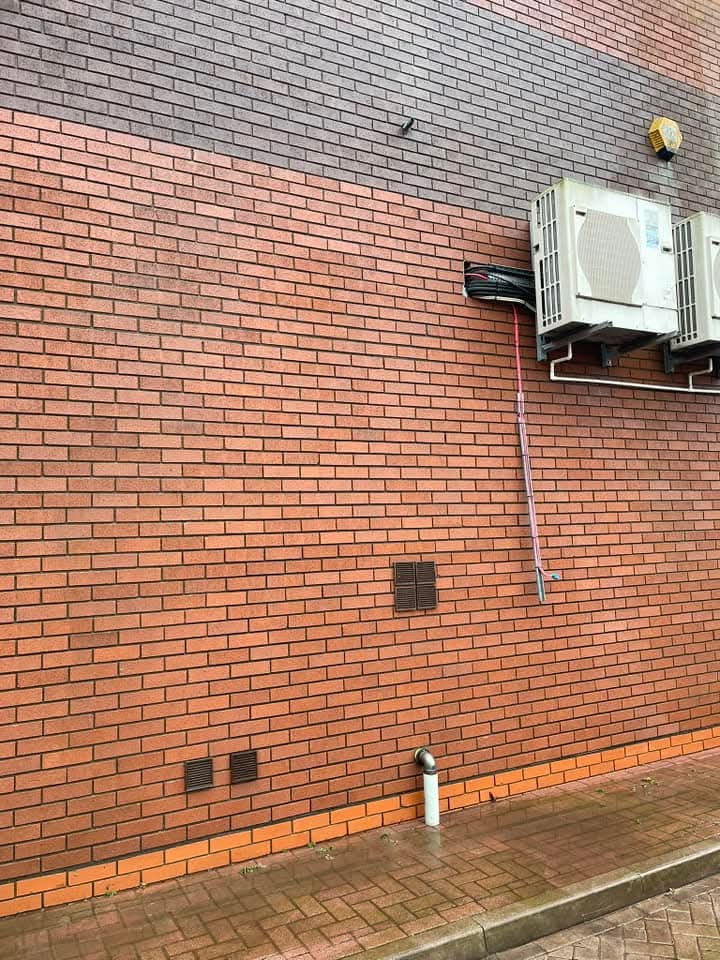 After
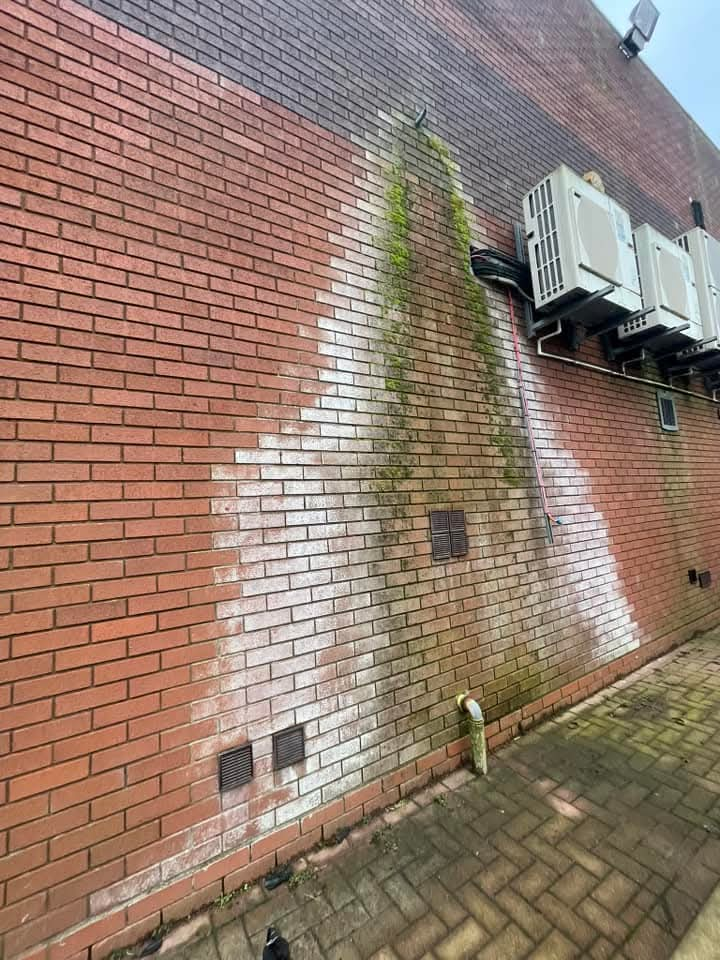 Before
Project Overview
Supreme Exterior Clean was contacted to restore a heavily stained section of exterior brickwork at Pure Fishing's commercial premises in Cramlington, Northumberland.
Over approximately twelve months, water escaping from a faulty overflow pipe had caused extensive discolouration across the building's brick façade. What initially appeared as relatively minor staining had deteriorated considerably during the preceding three months, leaving a large area of brickwork covered in white mineral deposits, dark staining and green algae.
Although the underlying plumbing issue had already been repaired, the staining remained firmly embedded on the brickwork, significantly affecting the appearance of the property.
Our task was to identify the various types of contamination and develop a cleaning process capable of restoring the brickwork without causing damage to the bricks, mortar joints or surrounding fixtures.
The Challenge: Three Different Types of Contamination
One of the main challenges was that the discolouration was not caused by a single contaminant.
Our initial assessment identified three separate problems, each requiring a different cleaning approach.
1. Hard Water Staining
The most extensive contamination consisted of stubborn white mineral deposits caused by water repeatedly running down the brickwork.
As the water evaporated, dissolved minerals were left behind, gradually accumulating into increasingly noticeable deposits.
Unlike general surface dirt, these mineral deposits cannot reliably be removed through conventional pressure washing alone.
2. Efflorescence
Some of the remaining white staining was caused by efflorescence, a process in which soluble salts migrate through masonry and crystallise on the surface as moisture evaporates.
Although efflorescence can appear similar to hard water staining, understanding the difference is important when selecting an effective cleaning treatment.
3. Algae Growth
The constant presence of moisture had also encouraged green algae to develop along the paths of water runoff.
This biological contamination contributed to the dark and green discolouration visible across the affected brickwork.
The challenge was not simply removing the visible staining, but correctly identifying and treating the different contaminants without damaging the building's exterior.
Our Solution: A Carefully Sequenced Chemical Cleaning Process
Because the brickwork was affected by several different types of contamination, we adopted a staged cleaning process, using specialist chemical treatments selected for each problem.
Stage 1: Algae Removal
We began by treating the biological contamination with a sodium hypochlorite-based cleaning solution.
The treatment was carefully applied and agitated to break down the algae growing on the brickwork.
Addressing this contamination first allowed us to remove the biological growth before tackling the more stubborn mineral deposits.
Stage 2: Hard Water Stain Removal
Following our initial assessment, we suspected that the majority of the white staining consisted of mineral deposits left behind by the overflowing water.
We therefore selected a phosphoric acid-based treatment to dissolve the hard water deposits.
This proved to be the most demanding part of the cleaning process.
To minimise the risk of damaging the brickwork and surrounding materials, we favoured a relatively mild treatment rather than an excessively strong acid concentration.
As a result, several applications were required to progressively break down and remove the accumulated mineral staining.
The cleaning solution was manually agitated using brushes, allowing our technicians to work carefully across the affected surfaces.
Stage 3: Efflorescence Removal
Once the majority of the hard water staining had been removed, some residual white deposits remained.
These were treated separately using a carefully controlled hydrochloric acid-based cleaning solution, selected to address the remaining mineral and salt deposits.
This final chemical treatment enabled us to remove the remaining visible white staining and restore a more consistent appearance to the brickwork.
Stage 4: Final Low-Pressure Rinse
Once the chemical cleaning stages were complete, the brickwork received a final thorough rinse using a pressure washer fitted with a low-pressure rinsing nozzle.
This allowed us to remove the loosened contamination and cleaning residues without exposing the brickwork and mortar joints to unnecessarily high water pressure.
Additional Considerations: Protecting the Building
The affected section of brickwork was situated immediately beside several externally mounted air-conditioning units.
This presented an additional challenge, as the cleaning treatments needed to be carefully controlled around the equipment.
Rather than applying chemicals indiscriminately across the façade, our technicians worked by hand using brushes and controlled application methods.
Access to the affected areas was achieved using ladders, allowing the team to complete the work without the need for more extensive access equipment.
The combination of careful chemical application, manual agitation and low-pressure rinsing was central to achieving the required result.
The Results: Restored Brickwork in Just One Day
The entire cleaning project was successfully completed within a single working day.
The results were a dramatic improvement.
The extensive white mineral staining was removed, the algae was eliminated, and the original red and dark brickwork colours became visible once again.
Importantly, these results were achieved without relying on aggressive high-pressure cleaning methods.
The client was extremely satisfied with both the finished appearance and the overall service provided.
They particularly commented on Supreme Exterior Clean's technical knowledge and the smooth handling of the project, from the initial enquiry through to completion.
With the faulty overflow pipe having already been repaired before our arrival, the source of the excessive water discharge had also been addressed, helping reduce the likelihood of the same staining returning.
Expert Insight: Why Correctly Identifying Brickwork Staining Matters
White staining on brickwork is frequently assumed to be efflorescence. However, this is not always the case.
Hard water deposits, efflorescence and other mineral contamination can produce similar visual symptoms, despite having different causes.
Selecting an unsuitable cleaning method can lead to ineffective results or, in some circumstances, permanent damage to the brickwork.
Acid-based cleaning treatments also require particular care, as certain masonry materials and mortar joints can be vulnerable to chemical attack.
At Supreme Exterior Clean, we assess the nature of the contamination and the suitability of the surface before determining the most appropriate cleaning method.
This project demonstrates why specialist knowledge, correct chemical selection and controlled application techniques are essential when restoring heavily stained commercial brickwork.
It also highlights the importance of resolving the underlying source of moisture before carrying out remedial cleaning. Otherwise, the same contamination may quickly return.
Have a similar property requirement?
Contact Supreme Exterior Clean to arrange an assessment of your property and discuss the most appropriate cleaning solution.