
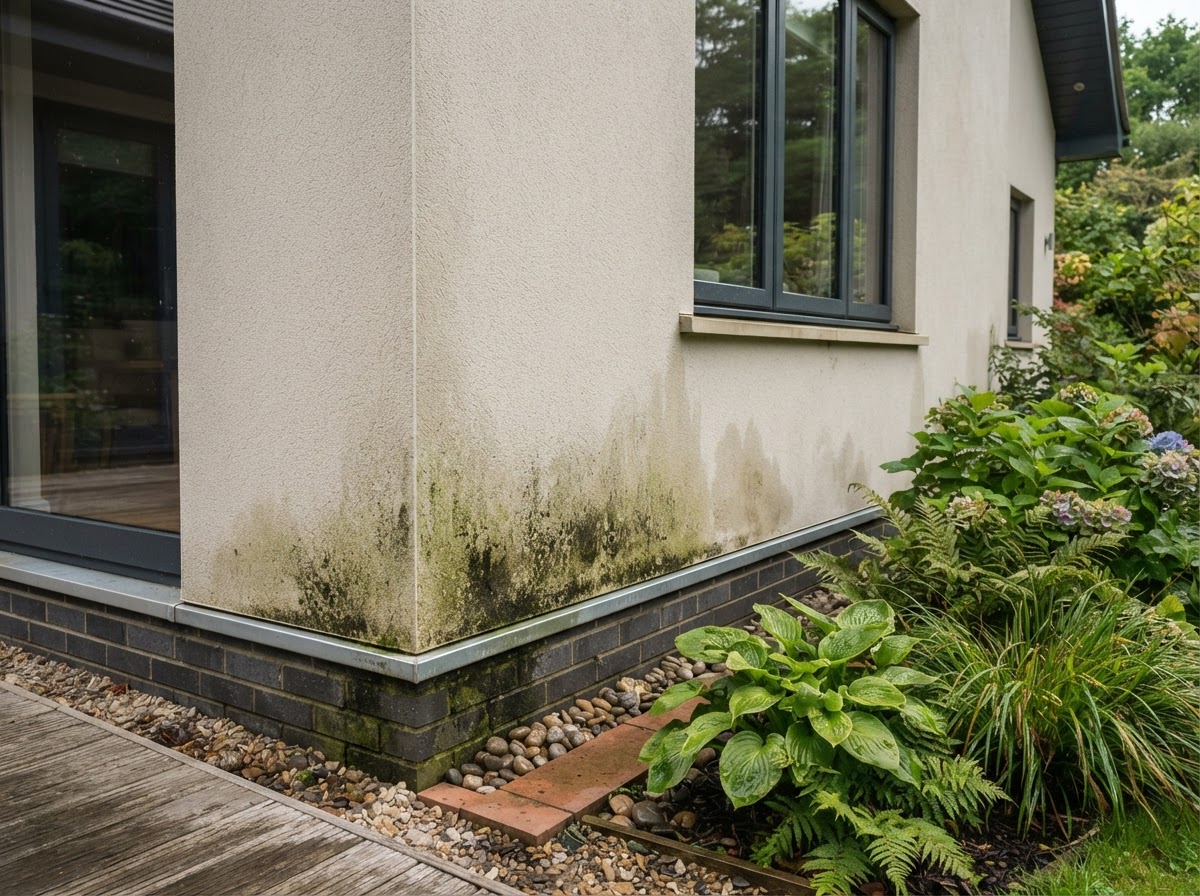
Your render might look dirty, but the wrong cleaning method could leave you with a much bigger problem than a few green stains.
If the render on your home has started turning green, red or black, you'll probably want to get it looking clean again.
And at first glance, pressure washing might seem like the obvious solution. After all, pressure washers are brilliant at removing dirt from patios, driveways and other hard surfaces.
But when it comes to render, the wrong pressure washing technique can cause permanent damage — potentially leaving you facing expensive repairs or even having to re-render parts of your property.
One of the biggest dangers is something most homeowners have never heard of: the 0-degree pressure washing nozzle.
What is a 0-degree nozzle, and why is it dangerous for render?
Pressure washers can use different nozzles to control how water is delivered onto a surface.
Some produce a wide, fan-shaped spray that distributes the water's force across a larger area. Others concentrate that force into a much smaller point.
A 0-degree nozzle produces an extremely narrow, concentrated jet of water. Rather than spreading the force across a wider surface, it directs it into a tiny area.
This makes it extremely aggressive.
Some contractors also use rotary or turbo nozzles. These spin a concentrated jet at high speed, producing a circular cleaning pattern while retaining a powerful impact on the surface.
These nozzles can be effective on certain hard materials, but they can physically score, cut into or erode rendered surfaces.
Imagine dragging a sharp object across a relatively soft surface. Instead of simply removing the dirt, you're removing some of the surface itself.
That's essentially what can happen when an excessively powerful, concentrated water jet is directed at render.
The result can be a series of visible lines, grooves or circular marks left behind by the cleaning equipment.
And unlike algae or dirt, these marks cannot simply be washed away.
Why the damage isn't always immediately obvious
One of the most frustrating aspects of pressure washing damage is that it isn't always apparent while the work is being carried out.
When render is wet, its colour changes and the surface can appear relatively uniform.
As the wall dries, however, the marks left by the pressure washer may become much more noticeable.
Homeowners can be left with:
- Visible lines and scoring: Where the water jet has physically cut into the render.
- Uneven surface texture: Where the pressure has removed or eroded part of the original finish.
- Patchy colouring: Where different areas have been cleaned or abraded more aggressively than others.
- Damaged coatings: Where paint or protective surface finishes have been stripped away.
- Water ingress risks: Where excessive pressure has aggravated cracks, weak points or existing defects.
In some cases, the damage is purely cosmetic. In others, the render system may have been sufficiently affected to require specialist repairs.
Unfortunately, once the original render texture has been physically damaged, simply cleaning it again won't restore the surface.
Not all render is the same
Another important consideration is that different types of render have different properties.
Modern properties commonly feature silicone, acrylic or monocouche render systems, while older buildings may have traditional sand-and-cement or lime-based finishes.
Some renders are relatively robust, while others have thin decorative finishes that require particular care.
Even within the same type of render, age, weathering, previous repairs and existing defects can affect how a surface responds to cleaning.
This is why identifying the render system before selecting a cleaning method is so important.
A method that might be acceptable on one surface could cause serious damage to another.
The real problem: using pressure to remove biological growth
Here's something many homeowners don't realise.
The green, red or black discolouration commonly seen on rendered buildings is frequently caused by biological contamination, such as algae, mould and other microorganisms.
These organisms thrive in damp environments, particularly on shaded elevations and walls exposed to prolonged moisture.
Pressure washing attempts to remove that contamination primarily through physical force.
But this isn't necessarily the most effective or appropriate way to deal with it.
While a powerful water jet may remove the visible growth, it can also damage the render beneath it. And simply washing away the visible contamination doesn't necessarily provide effective control of the remaining biological growth.
The better approach is often to use a specialist cleaning treatment designed to target the contamination itself.
Rather than relying on force to blast the surface clean, we use cleaning chemistry to do the hard work.
So how should render be cleaned?
At Supreme Exterior Clean, our preferred method for cleaning biologically contaminated render is generally a process known as softwashing.
Softwashing uses carefully selected cleaning solutions, applied at low pressure, to treat organic contamination without subjecting the render to the aggressive mechanical force of conventional high-pressure cleaning.
Depending on the render system and the nature of the contamination, we may use specialist biocidal treatments or other compatible cleaning solutions.
The process typically involves:
- Assessing the render: Identifying the type of render, its condition and the contamination present.
- Selecting the treatment: Choosing a suitable cleaning product and application method.
- Applying the solution: Treating the affected surface using controlled, low-pressure equipment.
- Allowing the treatment to work: Giving the cleaning chemistry sufficient contact time to act on the contamination.
- Rinsing or allowing natural weathering: Depending on the product and process, the surface may be gently rinsed or left for the treatment to work progressively.
The result is a cleaning process focused on removing contamination while preserving the render's original appearance and texture.
Some treatments produce an immediate visual improvement, while others continue to work over the following weeks.
Does this mean render should never be pressure washed?
Not necessarily.
Some render manufacturers permit pressure washing under specific conditions, using controlled pressure, an appropriate fan-shaped nozzle and a suitable distance from the surface.
However, this is very different from directing a concentrated high-pressure jet at the wall.
The suitability of pressure washing depends on the particular render system, its condition and the manufacturer's cleaning recommendations.
A professional cleaning company should understand these differences and select its cleaning method accordingly.
The important distinction isn't simply whether water pressure is used. It's whether that pressure is appropriate for the material being cleaned.
How often should render be cleaned?
The frequency of render cleaning depends heavily on the property's surroundings and orientation.
Walls that receive plenty of sunlight and dry quickly can remain clean for many years. In some cases, south-facing elevations may go ten years or longer without requiring significant cleaning.
North-facing walls, heavily shaded areas and elevations surrounded by trees can develop biological growth much sooner.
Rather than recommending unnecessary annual cleaning, we believe render should be assessed and treated when its condition justifies it.
Using an appropriate treatment can also help slow the return of biological contamination, reducing the need for repeated cleaning.
Choose the right cleaning method, not simply the cheapest quotation
Your home's render is an important part of its external appearance, and repairing a damaged finish can be considerably more expensive than having it professionally cleaned in the first place.
Before appointing a contractor, it's worth asking a few straightforward questions:
- What type of render do I have?
- What cleaning method will you use?
- Will you use a high-pressure jet, a rotary nozzle or a low-pressure treatment?
- What chemicals will be applied, and are they suitable for my render?
- How will you protect the render from damage?
A competent specialist should be able to explain their proposed method and why it's suitable for your particular property.
At Supreme Exterior Clean, we believe understanding the surface is just as important as understanding how to clean it.
Our approach is built around choosing the correct treatment for the material and contamination, rather than applying the same cleaning technique to every building.
Thinking about having your render cleaned?
If your home or commercial property is showing signs of algae, red staining or other discolouration, we're happy to assess the surface and recommend an appropriate cleaning method.
Send us a few photographs of the affected areas, and our team can advise you on the next steps.
Request a Render Cleaning Quotation
Send us a few photographs of your affected render and our team can advise on the safest, most appropriate cleaning method for your property.