
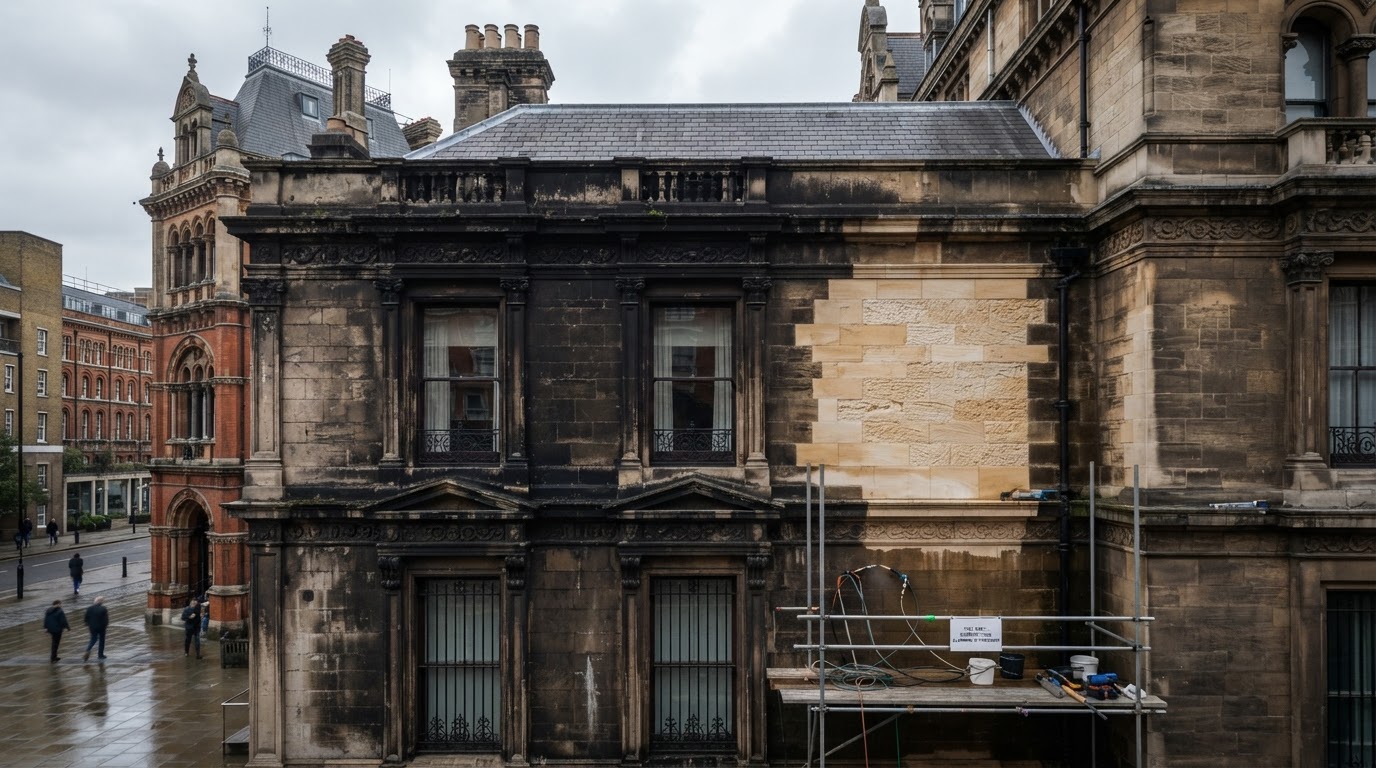
The black staining on Britain's older stone buildings could be the legacy of more than a century of coal burning. Fortunately, much of the pollution responsible is now a thing of the past.
Walk through almost any historic town or city in the UK and you'll notice something interesting about many of the older stone buildings.
Beautiful sandstone and limestone properties that were originally much lighter in colour are now covered in dark grey or black staining.
On some buildings, the discolouration is particularly noticeable around windows, beneath architectural features and in sheltered areas of the stonework.
Many homeowners assume this is simply dirt that has accumulated over time.
But the true explanation is often far more interesting.
Much of the black staining found on Britain's older stone buildings is a legacy of the country's industrial past, when millions of homes and businesses relied on burning coal for warmth and energy.
And although these deposits can be extremely difficult to remove, the good news is that the pollution responsible for much of the historic staining has declined dramatically.
A legacy of Britain's coal-burning past
To understand why so many older buildings have blackened stonework, we need to go back to a time when coal was a fundamental part of everyday life.
For generations, millions of British households relied on open coal fires to heat their homes.
On cold winter days, chimneys across towns and cities would release enormous amounts of smoke into the atmosphere.
Factories, mills, railway locomotives and industrial furnaces added even more pollution.
In industrial regions such as Newcastle, Durham and the wider North East, coal was central to the local economy.
But all that coal burning came with an unfortunate consequence.
The smoke contained tiny particles of soot, carbon and other pollutants that travelled through the air before eventually settling on surrounding buildings.
Year after year, these particles accumulated on exposed stonework.
Rain washed some deposits away, but other particles became trapped within the stone's textured and porous surface.
Over decades, this gradual accumulation transformed the appearance of many buildings.
What had once been attractive, light-coloured stonework became dark grey, brown or almost completely black.
And because this process happened so slowly, the discolouration became part of the familiar appearance of Britain's historic towns and cities.
Why does carbon staining cling so stubbornly to stone?
One of the reasons historic black staining is so difficult to remove is the nature of the stone itself.
Many traditional building stones, particularly sandstone and limestone, have a porous structure.
This means their surfaces contain tiny openings and irregularities where moisture and fine particles can collect.
When soot and carbon particles settle on these surfaces, they don't necessarily remain as a loose layer of dirt that can simply be washed away.
Over time, particles can become embedded within the surface texture and combine with other environmental deposits.
Repeated wetting and drying can further consolidate the staining.
This explains why ordinary pressure washing may fail to remove deeply established black contamination.
The problem isn't necessarily the amount of dirt on the stone. It's how firmly that contamination has become attached to the material.
In some situations, attempts to remove the staining using excessive pressure can damage the stone before the black deposits have been successfully removed.
Black carbon deposits aren't always just soot
There's another important part of the story.
Coal smoke didn't simply release black carbon particles. It also released gases, particularly sulphur dioxide.
When sulphur dioxide reacts with moisture and certain minerals in limestone and other calcium-rich building materials, it can contribute to the formation of calcium sulphate, commonly known as gypsum.
These mineral deposits can trap soot and other airborne particles, gradually forming a hard, dark surface layer.
This is often referred to as a black sulphate crust.
These crusts are particularly common in sheltered areas of historic stone buildings where rainwater doesn't regularly wash the surface.
Unlike ordinary surface dirt, a black sulphate crust can be chemically associated with the underlying stone.
This makes removal considerably more challenging.
It also means that aggressive cleaning could cause damage to the original stonework.
Not all black staining is a sulphate crust. The composition depends on the stone and its environmental history, which is why identifying the contamination is so important before attempting removal.
Why are some parts of a stone building darker than others?
You might have noticed that black staining isn't always distributed evenly across a building.
Some areas can appear almost black, while neighbouring sections remain relatively clean.
There are several reasons for this.
- Sheltered areas: Stone beneath window ledges, decorative mouldings and overhanging features receives less direct rainfall. This allows soot and pollution deposits to accumulate over many years.
- Stone texture: Rough or heavily weathered surfaces can trap more contamination than smoother finishes.
- Building orientation: Different elevations experience different wind, rain and environmental conditions.
- Architectural features: Recesses, carvings and intricate stonework create sheltered areas where deposits can build up.
- Local pollution sources: Buildings near historic industrial sites, busy roads or areas of intensive coal burning may have experienced greater levels of contamination.
These factors explain why the pattern of black staining can sometimes reveal something about a building's environmental history.
Why is this staining much less likely to develop as severely today?
Here's the encouraging part.
Britain's air quality has changed enormously since the days when coal fires dominated domestic heating.
The introduction of smoke control measures, the decline of coal-fired domestic heating, changes in industry and cleaner energy production have all helped reduce atmospheric pollution.
The UK has also been moving towards lower-carbon energy sources.
According to government emissions statistics, UK sulphur dioxide emissions fell by approximately 98% between 1990 and 2024.
Emissions of fine particulate matter, which includes some of the tiny particles associated with combustion, have also fallen substantially.
This matters for stone buildings because the conditions responsible for much of the historic soot staining and sulphate crust formation are no longer as widespread or severe.
A stone building professionally cleaned today is generally much less likely to experience the same rapid accumulation of heavy coal-related deposits that occurred during Britain's industrial past.
That doesn't mean stonework can never become dirty again.
Traffic emissions, wood burning, industrial pollution and other airborne particles can still cause contamination.
However, the dramatic reduction in historic coal smoke pollution means that removing decades-old staining can deliver a long-lasting improvement.
Can historic carbon staining actually be removed?
Yes. In many cases, even heavily blackened stonework can be substantially improved through specialist cleaning.
However, historic carbon staining can be one of the more challenging forms of exterior contamination to remove.
The correct approach depends on several factors, including:
- The type and condition of the stone.
- Whether the staining is primarily soot, surface pollution or a sulphate crust.
- How deeply the contamination has penetrated.
- The age and historical significance of the building.
- Whether previous cleaning or weathering has damaged the surface.
At Supreme Exterior Clean, we approach this type of work as a specialist cleaning challenge rather than a conventional pressure washing job.
Depending on the material and contamination, our methods may include carefully controlled steam cleaning, specialist masonry cleaning solutions and targeted chemical treatments.
In some cases, a combination of methods is necessary.
We may also carry out test patches to assess how the stone responds before proceeding with more extensive cleaning.
For historic or particularly vulnerable stonework, conservation considerations are especially important.
Our aim is to remove unwanted contamination while preserving the stone beneath it.
Why pressure washing alone isn't always the answer
It's tempting to assume that increasing the water pressure will eventually remove stubborn black staining.
Unfortunately, this can be a costly mistake.
Some natural stones are relatively soft, and excessive pressure can erode their surface.
Powerful, concentrated water jets can also damage mortar joints, remove weathered stone and leave visible cleaning marks.
In particularly vulnerable masonry, the original surface may begin to deteriorate before the firmly attached black deposits are removed.
Specialist cleaning requires an understanding of both the material and the contaminant.
Sometimes chemical treatment is needed to loosen deposits. Sometimes controlled steam cleaning can help. In other cases, conservation-led methods may be necessary.
The important thing is recognising that more pressure doesn't automatically mean better cleaning.
Will the stone look brand new afterwards?
Professional carbon stain removal can produce remarkable transformations.
Stonework that has appeared almost black for decades can sometimes reveal attractive natural colours that have been hidden for generations.
However, not every building can or should be returned to a completely uniform, freshly quarried appearance.
Some staining may be deeply embedded, while sections of the stone may have undergone permanent weathering or chemical alteration.
Historic buildings may also have established surface patinas that should be preserved.
Overly aggressive cleaning in pursuit of a perfectly uniform colour can remove original material and compromise the character of the building.
For this reason, we believe successful stone cleaning should be measured by the improvement achieved and the preservation of the underlying stone, rather than simply how light the surface becomes.
A chance to reveal the original beauty of Britain's stone buildings
There is something particularly rewarding about restoring historic stonework.
When decades of black contamination are carefully removed, the results can reveal natural colours, textures and architectural details that have been obscured for much of a building's recent history.
And unlike the generations when coal smoke was constantly being deposited on surrounding buildings, we now live in an environment with substantially lower levels of many of the pollutants responsible.
That means a carefully restored stone building may retain its improved appearance for many years, subject to its location and ongoing environmental exposure.
At Supreme Exterior Clean, we combine specialist cleaning chemistry, professional equipment and an understanding of different masonry materials to tackle challenging exterior staining.
Whether you're responsible for a traditional sandstone home, an older commercial property or a larger stone building, we can assess the contamination and recommend an appropriate cleaning solution.
Is your stone building affected by black staining?
If your property's stonework is covered in stubborn black deposits, you may be surprised by how much its appearance could improve.
Send our team a few photographs of the affected areas via WhatsApp, and we can advise on the most appropriate next steps.
Request a Specialist Stone Cleaning Quotation
Send us a few photographs of your affected stonework and our team can advise on the most appropriate cleaning method for your building.