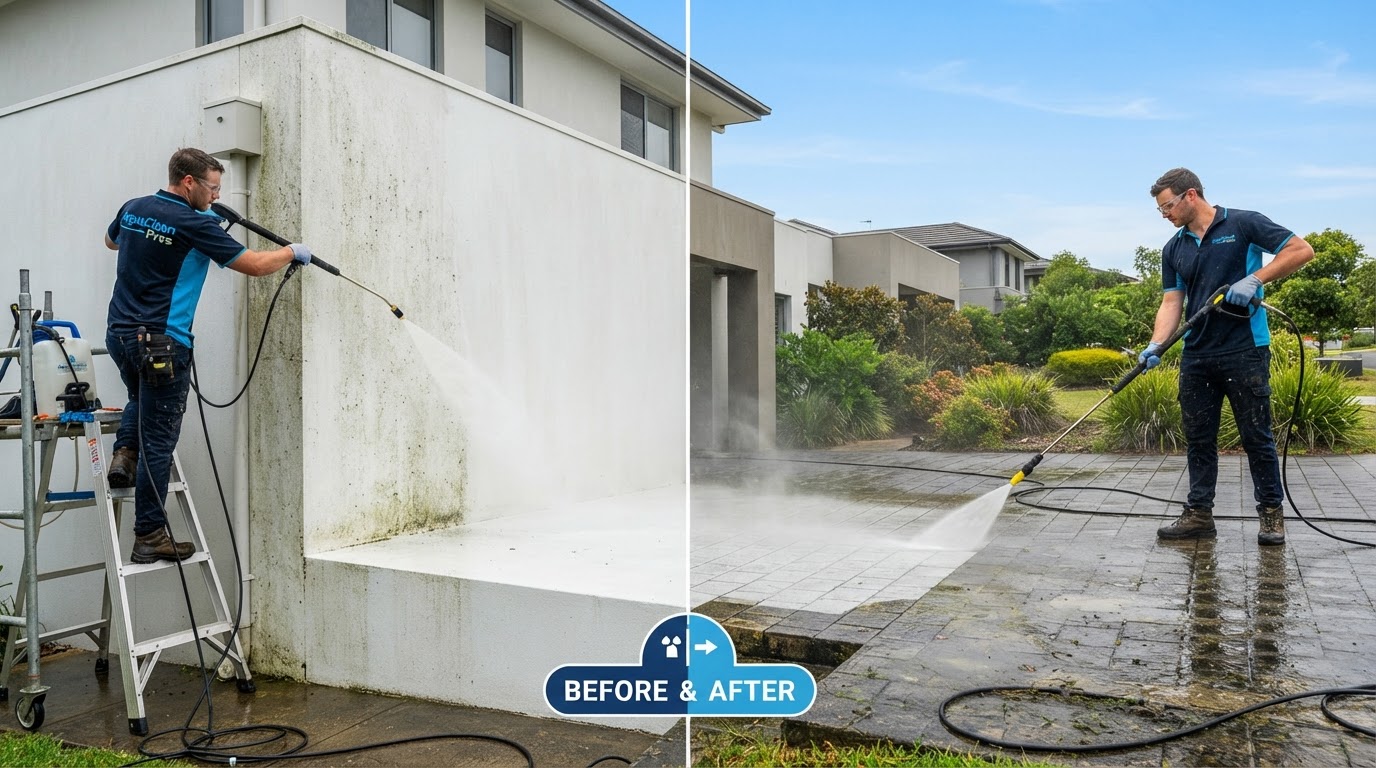
Softwashing and pressure washing are two of the most widely used methods in professional exterior cleaning. But is one really better than the other? The answer might surprise you.
If you've been researching exterior cleaning services, you've probably come across two terms: pressure washing and softwashing.
You may even have read claims suggesting that softwashing is always safer, that pressure washing damages surfaces, or that one method delivers better results than the other.
The reality is considerably more complicated.
Both methods are extremely effective when used correctly. Both have limitations, and both can cause serious damage if used inappropriately.
In fact, professional exterior cleaning often involves combining the two techniques.
At Supreme Exterior Clean, we believe the question shouldn't be whether softwashing or pressure washing is better.
The real question is: which cleaning method is appropriate for the surface, the contamination and the result we're trying to achieve?
What is pressure washing?
Pressure washing is a cleaning method that uses water delivered through specialist equipment at a controlled pressure.
The mechanical force of the water helps dislodge and remove dirt, debris, biological growth and other unwanted materials from surfaces.
However, one of the biggest misconceptions about pressure washing is that it always involves extremely powerful water jets.
In reality, pressure washing equipment can operate across a very wide range of pressures, depending on its design and intended purpose.
A contractor might use relatively low pressure to rinse a delicate surface, moderate pressure to clean suitable paving, or much higher pressure to remove stubborn deposits from robust materials.
At the extreme end of the spectrum, specialist industrial water-jetting equipment can operate at pressures powerful enough to remove concrete.
This is known as hydrodemolition.
It demonstrates just how versatile pressurised water can be.
The same basic principle — using the energy of moving water — can be adapted for everything from gentle rinsing to industrial material removal.
Of course, the equipment and safety requirements involved are very different.
Why the degree of pressure matters
When assessing pressure washing, it's important to understand that cleaning effectiveness isn't determined by pressure alone.
Several factors influence the impact of the water on a surface:
- Water pressure: The pressure generated by the equipment and delivered through the nozzle.
- Water flow: The volume of water moving through the system.
- Nozzle selection: Whether the water is delivered as a narrow, concentrated jet or distributed across a wider spray pattern.
- Distance from the surface: The distance between the nozzle and the material being cleaned.
- Angle of application: The direction in which the water strikes the surface.
- Exposure time: How long the water jet remains concentrated on one area.
These variables can make an enormous difference.
For example, a narrow 0-degree nozzle concentrates the water into a powerful jet. This can be useful for certain specialist applications, but it can also score or erode vulnerable surfaces.
A wider fan nozzle distributes the water's force across a larger area, reducing its concentrated impact.
The lesson is simple.
Pressure washing is not inherently aggressive. It becomes aggressive when the equipment and settings produce more mechanical force than the surface can safely withstand.
When is pressure washing the right choice?
Pressure washing is particularly effective when contamination can be removed mechanically and the underlying surface is sufficiently robust.
Common applications include:
Patio and driveway cleaning
Suitable concrete paving, block paving and certain natural stones can often be cleaned efficiently using professional pressure washing equipment.
Rotary surface cleaners can help achieve consistent results across larger paved areas.
However, some delicate stones, jointing materials and surface finishes require much more careful treatment.
Removing mud, dirt and loose deposits
Where contamination consists primarily of loose dirt, mud or debris, pressurised water can be highly effective without requiring specialist cleaning chemicals.
Removing certain coatings and construction residues
More powerful water-jetting equipment can be used for specialist applications, including removing some coatings, surface deposits and construction materials.
With appropriate industrial equipment, water jetting can even remove hardened concrete.
This is an application where softwashing simply cannot provide the same mechanical removal capability.
Commercial and industrial cleaning
Pressure washing is used extensively for maintaining hardstanding areas, loading bays, industrial surfaces and other suitable commercial environments.
The pressure, flow and equipment must always be matched to the material and task.
What is softwashing?
Softwashing is a cleaning method that relies primarily on carefully selected cleaning chemicals rather than the mechanical force of high-pressure water.
The solutions are generally applied at relatively low pressure and allowed to work on the contamination.
Depending on the product and cleaning process, the surface may then be rinsed or left for the treatment to act progressively.
Softwashing is particularly effective for many forms of biological contamination, including algae, mould and certain types of lichen.
Instead of relying solely on water pressure to physically remove the visible growth, suitable cleaning products act on the organisms themselves.
This makes softwashing especially useful where aggressive mechanical cleaning would risk damaging the underlying surface.
However, there's an important distinction.
Softwashing describes a cleaning approach. It doesn't automatically mean the process is safe for every surface or environment.
When is softwashing the right choice?
Softwashing is especially useful where the contamination responds well to chemical treatment or where the material requires a gentler mechanical approach.
Render cleaning
Many rendered surfaces are vulnerable to damage from concentrated high-pressure water jets.
Specialist softwashing treatments can remove or control biological contamination without relying on aggressive pressure.
This makes softwashing particularly useful for suitable silicone, acrylic and monocouche render systems.
Roof cleaning and moss treatment
Once heavy moss deposits have been removed where necessary, a suitable biocide treatment can help control remaining biological growth and delay regrowth.
In some circumstances, chemical treatment alone may be appropriate.
Algae and organic staining
Biological contamination on suitable masonry, cladding and other exterior materials can often respond well to specialist chemical treatments.
Preventative maintenance
Certain biocidal treatments may provide residual protection against biological growth for a period after application.
This makes them useful within planned maintenance programmes designed to reduce the need for repeated intensive cleaning.
Is softwashing safer than pressure washing?
Not automatically.
It's true that softwashing generally involves lower mechanical pressure, reducing certain risks associated with aggressive water jets.
But that doesn't make it risk-free.
Many professional softwashing products contain chemicals that require careful handling.
For example, sodium hypochlorite-based cleaning solutions are commonly used for certain types of biological contamination.
Depending on their concentration and formulation, these chemicals can be hazardous to people, plants, animals and the wider environment.
Incorrect application can also damage or discolour certain building materials.
Potential risks associated with softwashing include:
- Chemical burns or irritation to skin and eyes.
- Respiratory exposure to hazardous mists or vapours.
- Damage to sensitive plants and surrounding vegetation.
- Discolouration or deterioration of incompatible materials.
- Environmental contamination through uncontrolled runoff.
- Dangerous chemical reactions caused by mixing incompatible products.
In particular, chlorine-based products must never be mixed with acids or ammonia-containing products because hazardous gases can be released.
Professional chemical cleaning therefore requires appropriate training, product knowledge, protective equipment and risk assessments.
In the UK, commercial use of hazardous cleaning substances is subject to the Control of Substances Hazardous to Health (COSHH) Regulations.
Reducing the pressure doesn't remove the need to understand the risks associated with the cleaning chemicals.
Can pressure washing damage surfaces?
Absolutely — when it is used incorrectly.
Excessive water pressure can cause permanent damage to materials that aren't capable of withstanding the force.
Examples include:
- Render: Concentrated jets can score, erode or remove textured finishes.
- Natural stone: Softer stones can suffer surface erosion, loss of detail or damage to weathered layers.
- Brickwork: Excessive pressure can damage vulnerable brick faces and mortar joints.
- Roof tiles: Aggressive cleaning can disturb tiles and damage certain surface finishes.
- Timber: Powerful water jets can raise the grain, splinter fibres and damage protective coatings.
However, these risks don't mean pressure washing should never be used on these materials.
They mean the operator must understand the material, the equipment and the appropriate cleaning parameters.
The same principle applies to chemical cleaning.
A chemical that works extremely well on one material could cause irreversible staining or damage to another.
Can softwashing remove everything that pressure washing can?
No, and this is an important distinction.
Softwashing excels at treating certain forms of contamination, particularly biological growth.
However, some deposits require mechanical force to remove them effectively.
Consider hardened concrete attached to a suitable industrial surface.
A biocide treatment designed to remove algae will not remove that concrete.
Specialist high-pressure or ultra-high-pressure water jetting, on the other hand, may be capable of removing it.
Similarly, thick accumulations of mud, loose debris and certain other materials can be removed efficiently using pressurised water.
Conversely, using high pressure to remove biological contamination from delicate render may be unnecessarily aggressive when a suitable chemical treatment could achieve the result with much less mechanical force.
The best cleaning method is determined by what needs removing and what material lies underneath it.
Sometimes the best solution is to combine both methods
In professional exterior cleaning, softwashing and pressure washing don't always operate as separate techniques.
Often, the most effective approach combines mechanical cleaning with specialist chemical treatments.
For example, a heavily contaminated patio might require:
- A specialist chemical treatment to address stubborn biological growth.
- Controlled pressure washing to remove accumulated dirt and debris.
- A targeted follow-up treatment for remaining lichen or staining.
- Appropriate rinsing and inspection to assess the finished surface.
Likewise, specialist roof cleaning might involve manual moss removal followed by a preventative biocide treatment.
In both cases, different techniques perform different functions.
The cleaning chemistry addresses contamination that responds to chemical treatment, while mechanical cleaning removes material that requires physical force.
Used together, and when appropriate for the surface, these methods can achieve results that would be difficult to obtain using either technique alone.
What about environmental considerations?
Both methods have environmental implications.
Pressure washing can consume considerable volumes of water, depending on the equipment, flow rate and duration of the work.
It can also generate contaminated wastewater containing dirt, oils, chemicals or other materials removed from the surface.
Softwashing may use less water for certain applications, but the cleaning products themselves can present environmental risks.
Some chemicals can be harmful to aquatic organisms and vegetation, particularly if they enter surface drains or watercourses.
For this reason, the environmental impact of a cleaning operation cannot be judged simply by whether it uses high pressure or chemicals.
Professional contractors should consider water consumption, chemical selection, runoff management and the surrounding environment when planning the work.
Neither method should automatically be described as the environmentally friendly option.
How does Supreme Exterior Clean choose the right method?
At Supreme Exterior Clean, we don't believe in applying the same cleaning method to every surface.
Our approach begins with understanding three important things:
1. The material
What is the surface made from? Is it sandstone, limestone, concrete, render, brick, metal or something else?
What condition is it in, and how might it react to pressure, water and cleaning chemicals?
2. The contamination
Are we dealing with algae, moss, atmospheric pollution, carbon staining, rust, paint, oil or hardened construction residues?
Different contaminants respond to different cleaning methods.
3. The desired result
Are we removing loose dirt, treating biological growth, restoring the appearance of a building or removing a particularly stubborn deposit?
We then select appropriate equipment, cleaning solutions and application techniques.
Sometimes that means low-pressure softwashing.
Sometimes it means controlled pressure washing.
And sometimes it means combining specialist chemical treatments with mechanical cleaning.
Our aim is always the same: achieve the best possible cleaning result while protecting the material being cleaned.
So, which is better: softwashing or pressure washing?
Neither method is universally better than the other.
Pressure washing offers mechanical cleaning power that can be extremely useful for removing dirt, debris and stubborn deposits from suitable materials.
Softwashing offers chemical cleaning capabilities that are particularly effective against biological contamination and can reduce the need for aggressive mechanical cleaning.
Both methods have limitations.
Both carry risks.
And both require technical knowledge to be used safely and effectively.
A good exterior cleaning contractor shouldn't simply specialise in using one method regardless of the circumstances.
They should understand when each technique is appropriate — and, just as importantly, when it isn't.
Ultimately, the quality of an exterior cleaning service isn't determined by whether the contractor uses softwashing or pressure washing. It's determined by their ability to choose and apply the right cleaning method for the job.
Need advice on cleaning your property?
Whether you're dealing with algae-covered render, a dirty patio, stained stonework or a more challenging exterior cleaning problem, Supreme Exterior Clean can help.
Our team uses a range of professional cleaning methods, specialist equipment and carefully selected treatments appropriate to different surfaces and contaminants.
Simply send us photographs of the areas you'd like cleaned via WhatsApp, and we'll advise you on the most suitable next steps.
Request an Exterior Cleaning Quotation
Send us a few photographs of the areas you'd like cleaned and our team can advise on the most appropriate cleaning method for your property.